An adoption model
Four ways of working with AI
 Von Andreas, 11.11.2026
Adoption ranges from AI doing part of your task to AI designing and running a whole process. This model helps you pick the mode that fits each type of work.
Two things change together across the modes. The unit handed over grows from a step inside the task to the process itself, and human action moves from inside the work to setting goals and governance. Everything else in the model follows from those two.
A repertoire, not a staircase. The mode numbers follow the size of the unit handed over. They are not a ranking, and the goal is not to move everything to mode 4. Some work belongs in mode 1 permanently: high-stakes and low-volume. Mature teams run all four modes at once, for different types of work.
Mode 1: same work, less time
Acceleration
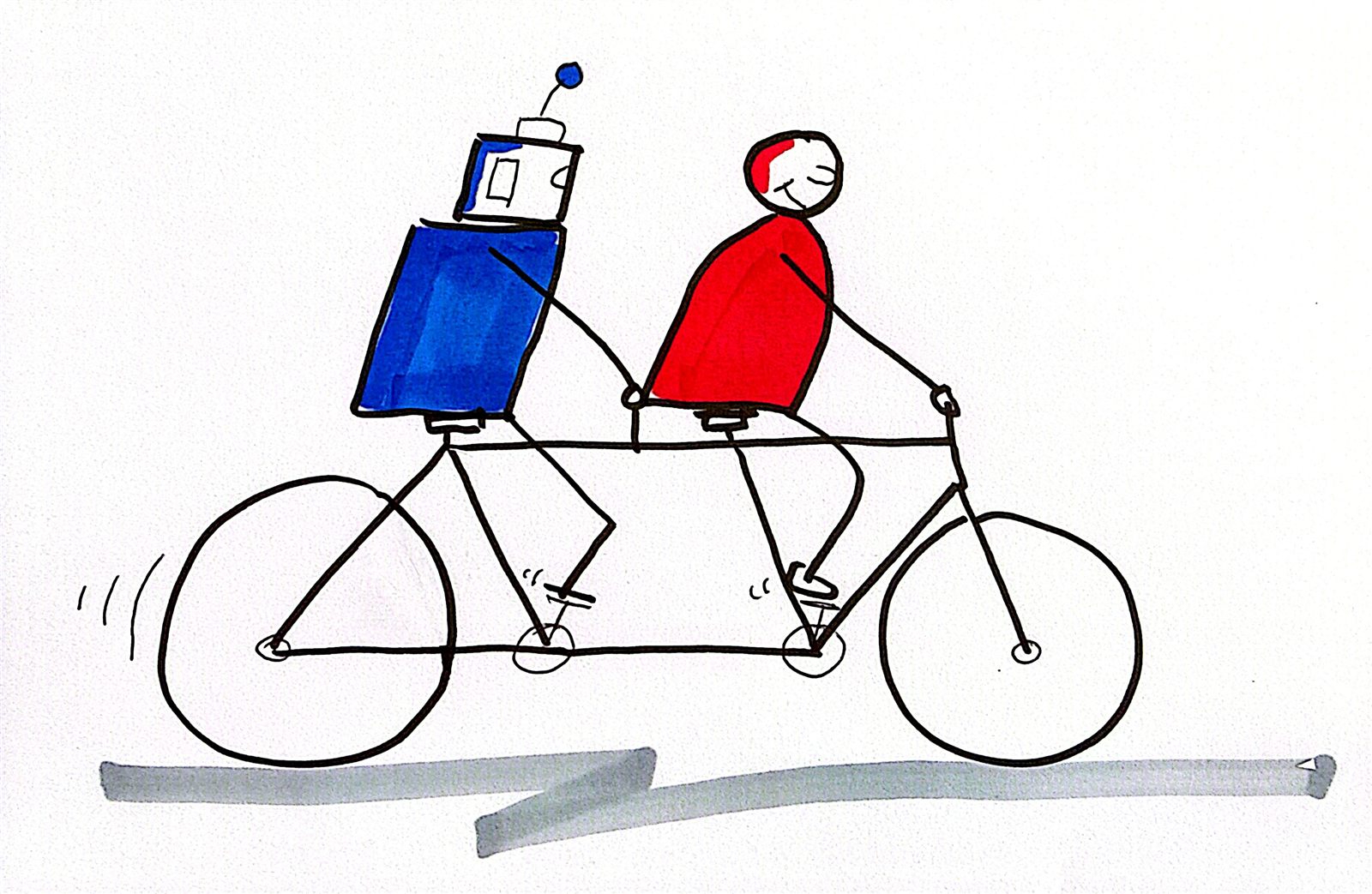 Wow! Fast & furious 🚀 I am capable of way more 😞
Work gets done faster while keeping its shape. The same person does the same task in the same order. AI compresses the slow parts: the blank page, the first draft, the syntax you'd have looked up, the document you'd have read in full. The result may also be better: an approach you didn't know, a case you hadn't considered.
Signal. If AI vanished tomorrow, your process would be identical, just slower.
Needs. Access and permission. That's genuinely all.
Traps
- Saved time disappears. Nobody decides where it goes, so it is absorbed by whatever each person was already behind on.
- Accepting what you did not check. AI output enters the work unread, or speed replaces a check you used to make.
Handing over parts of a task has a ceiling: the task itself stays with you. If you want to hand over the whole task, move from asking where can AI help me with this? to asking which of these tasks could I stop doing? Where the answer is yes, that task is ready for mode 2.
Mode 2: handing over whole tasks
Delegation
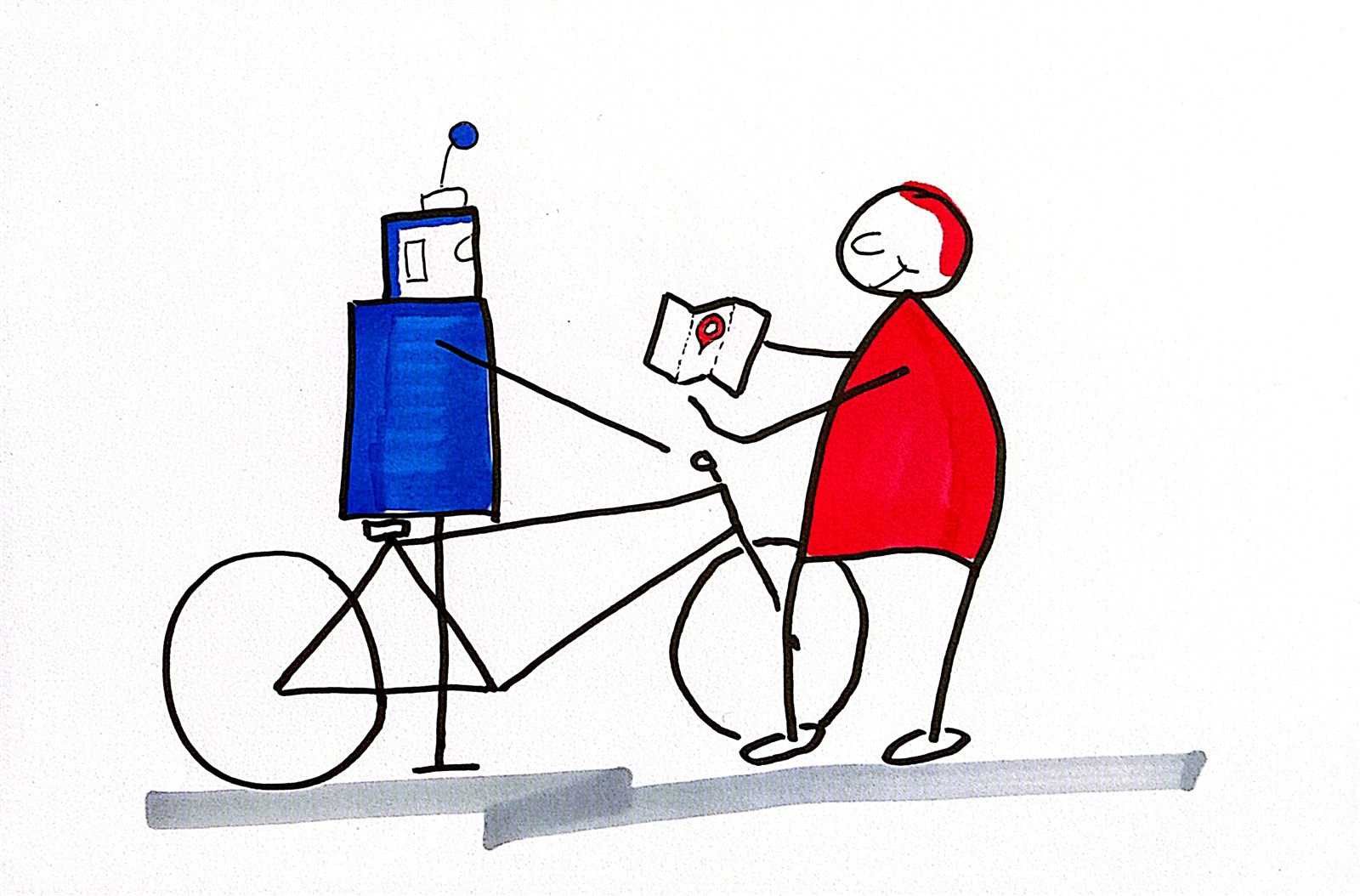 All I do is spec & check 😎 As if I could not decide where to go 🙈
The unit handed over is a whole task, not a step inside one. You specify, AI executes, you check. Your work here is briefing and reviewing, not producing. Those are different skills, ones most people have never had to be good at.
Signal. There are tasks you no longer do. Not do faster, no longer do.
Needs. You can say what done means before the work starts, and you can check the result more cheaply than producing it. If either fails, that task isn't ready to delegate.
Traps
- Delegating work whose verification costs more than doing it. This is a genuine negative return and it's the most common unforced error in this mode: the output arrives fast, looks plausible, and someone then spends longer checking it than they'd have spent writing it. They blame the output while the error was picking a task with no cheap check.
- The opposite trap: briefs so detailed that writing them costs what the task would have. Delegation only pays when saying what you want is cheaper than doing it.
If you notice you are explaining the same context every time, consider replacing the one-off brief with a standing responsibility for that recurring work. That is mode 3.
Mode 3: agents with standing responsibility
Collaboration
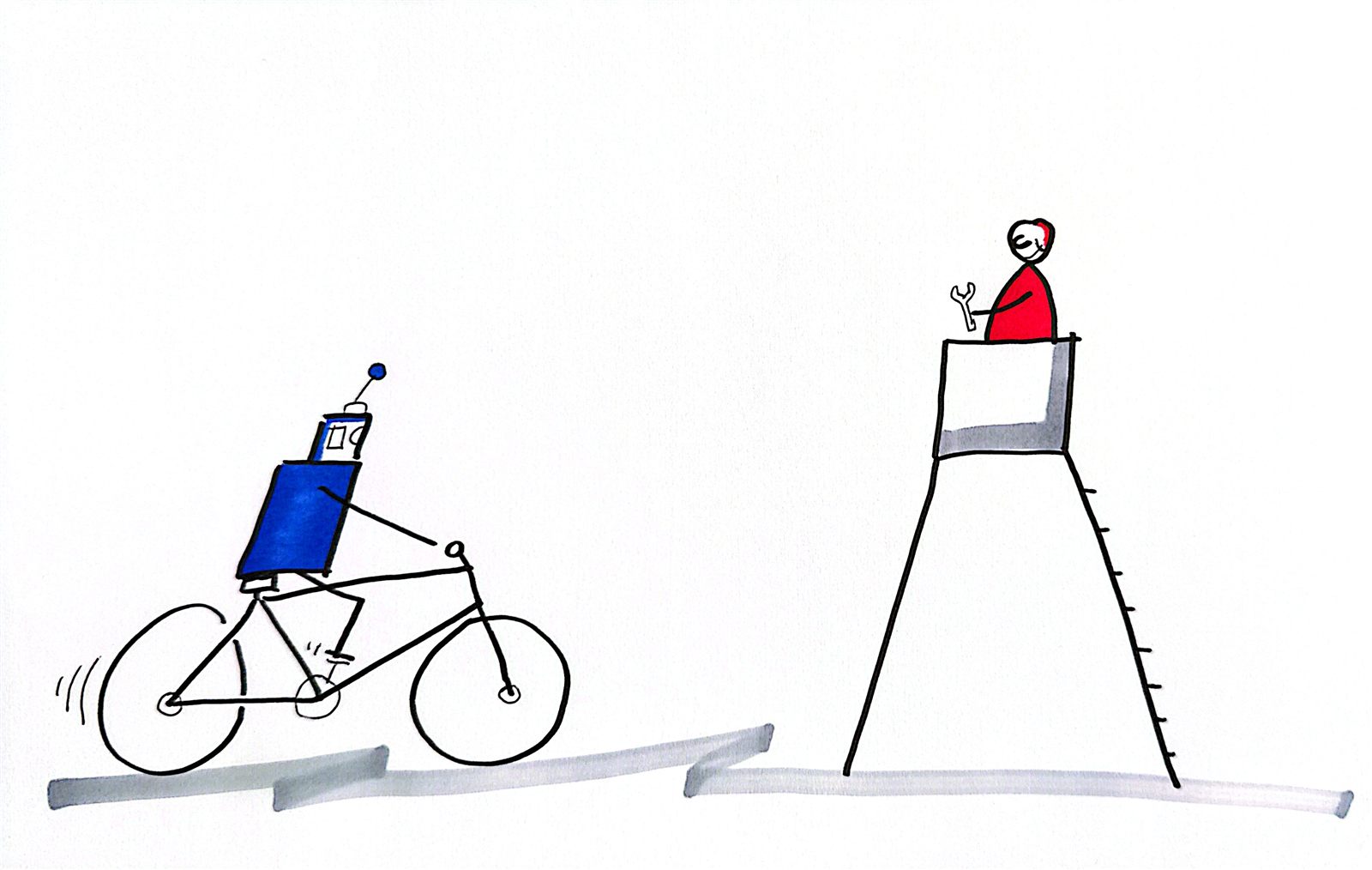 I really like my new colleague ❤️❤️ I enjoy the team spirit 😊
An agent holds a standing responsibility for a type of work. Its context persists between runs, it acts on a trigger rather than a request, and its output arrives whether or not you asked this morning. You set the objective and handle what it escalates.
Signal. Work gets done that no human started. There is something in your workflow you would now have to actively switch off.
Needs. What any colleague needs: access to the systems, context that survives between sessions, somewhere to report, and a named human accountable for its output. Plus, a written decision on what it may do without asking.
Traps
- Calling it a colleague while giving it nothing a colleague has: no memory between sessions, no system access, no supervisor, no way to learn from correction. Of course it underperforms. The underperformance is then read as evidence that AI isn't ready, when in fact the setup wasn't ready.
- The organizational version is quieter and harder. Review processes, permission models, and accountability lines all assume a human at the other end. None of them bend for an agent until somebody decides they should.
If you notice a pattern in the agent's escalations, ask which constraint the process behind it was designed around, for example that humans used to be the bottleneck. If that constraint no longer holds, consider letting the agent design the process. That is mode 4.
Mode 4: redesigning the work
Reinvention
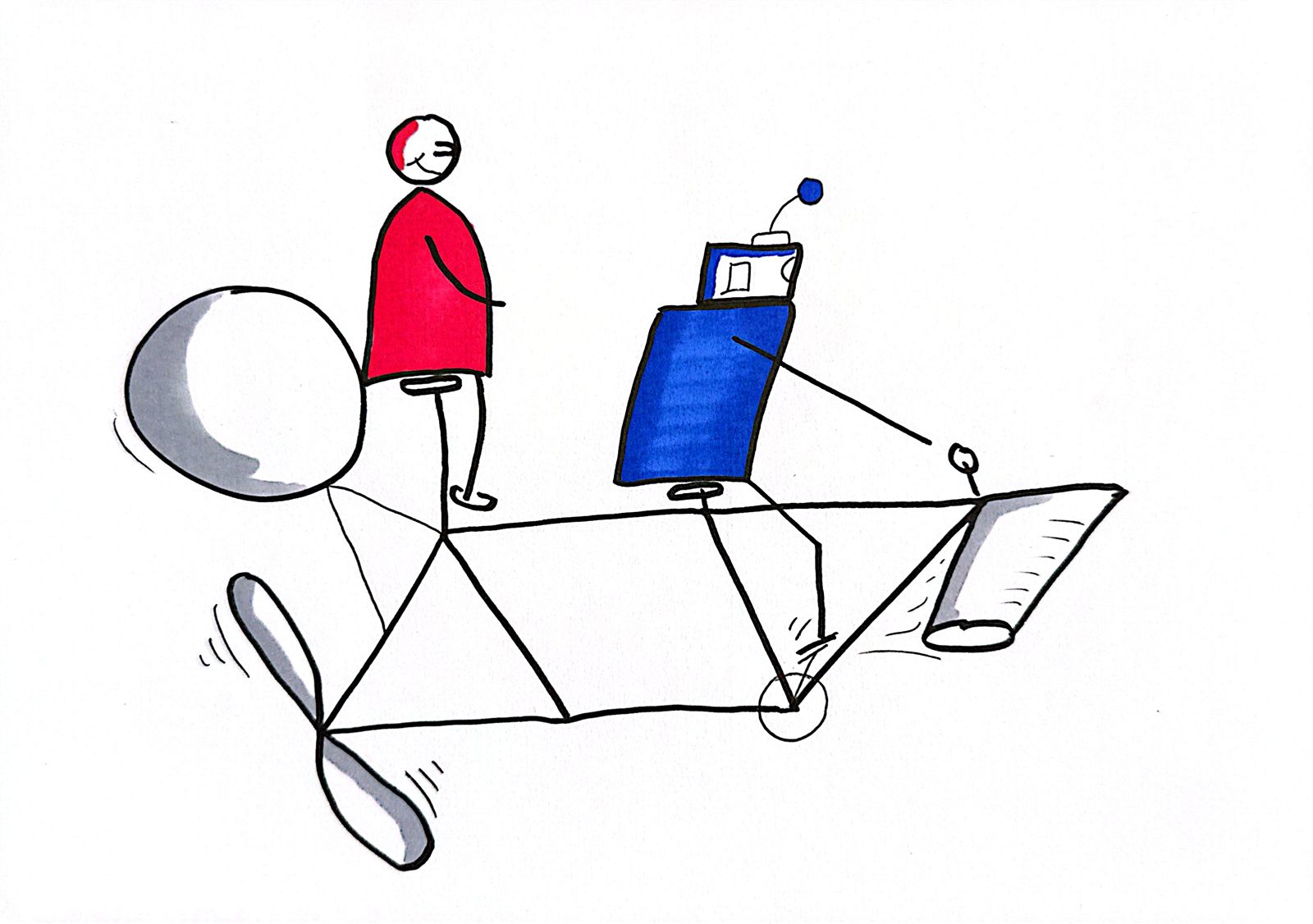 The future is now 🤩 I believe I can fly 🐦
You focus on goals, outcomes, and policies rather than the delivery process. The question is what work should exist at all, not how to do the current work or who does it. Most processes are fossils of a constraint: the cost of an expert hour, the batch size worth setting up for, the throughput one team could carry. When the constraint dissolves, the process it produced isn't efficient. It's just old. Thus, it's time for an agent to redesign it.
To start, take one process and name the constraint it was designed around. Then check, honestly, whether that constraint still binds. Sometimes it does, and that's a real answer too. If the constraint is obsolete, start from the objective and let the agent design the process.
Signal. You are doing things that have no earlier version. Not a faster take on the 2020 process, but something that would have made no sense to attempt then, because the economics forbade it.
Needs. Real operating experience with modes 2 and 3. You have to know where this capability is reliable and where it isn't, and that only comes from running it in production and being wrong a few times. Expect that. This is new territory, and nobody has a map yet.
Traps
- Redesigning around a capability you've only ever demoed. Build on what AI appears to do on a good day rather than what it does on a bad Tuesday, and you get a process that fails precisely where nobody thought to put a check.
- The opposite trap: never using this mode at all, and quietly settling for a permanently 20% faster version of the work you were already doing.
Handing over the design and operation of entire processes to AI is the exception today. Whether it becomes common is an open question.
Side by side
What changes across the modes
| Mode 1Acceleration | Mode 2Delegation | Mode 3Collaboration | Mode 4Reinvention | |
|---|---|---|---|---|
| Unit handed over | A step inside the task | A whole bounded task | A standing responsibility | The process itself |
| Handover artifact | Instructions | Brief | Responsibility definition | Goals and policies |
| Who initiates | The human, several times per task | The human, once per task | The agent, on its trigger | Built into the design |
| Human action | Continuously, inside the work | At the start and finish | At definition time and escalations | At goal definition |
| Way of steering | Hands on | By mid-distance destination | By standing route, on call for breakdowns | By far destination, hands off the wheel |
| Who holds context | The human | The human overall, the agent per task | The system, persistently | The system, by design |
| Process shape | Unchanged | Unchanged | Strained | Discarded |
| Limiting factor | Individual habit | Cost of verification | Org structures built for humans | Nerve, and real operating experience |
Same or better quality. Working with AI should hold or improve the quality of what you deliver. If you or your stakeholders notice a decline, look for the cause: a trap you have fallen into, a need that is not met, a skill still to build, or a mode that does not fit the type of work. If it is the mode, pick another, even if it has a lower number.
What to do with it
Pick the mode that fits the work
Product or feature development, contract review, investment memos: each type of work gets its own mode. What matters is that the choice is deliberate: name one type of work, place it honestly, and decide which mode it should be in.
Comments